RIS-3279-TOM & EN ISO 11612 Explained
 Trackside work presents two hazards at once: poor visibility around moving trains and the risk of flash fire or electric arc from overhead lines, welding, or fuel leaks. Most buying guides cover only one of these — hi-vis compliance under EN ISO 20471 — while ignoring flame retardant (FR) protection entirely. That’s a dangerous gap. A standard hi-vis vest, however brightly coloured, offers zero thermal protection. This guide combines both requirements, explaining what “dual-certified” hi-vis and FR clothing actually means, and reviewing seven garment types every UK trackside worker or safety buyer should know. Suppliers like Work & Wear Direct stock dual-certified rail workwear ranges, and the product knowledge below reflects the practical realities of specifying this kit correctly.
Why Rail Workers Need Dual-Certified FR + Hi-Vis Clothing (Not Just Hi-Vis)
Trackside environments carry compound risks: flash fires from fuel or hydraulic leaks, electrical arcs from 25kV overhead line equipment, and welding sparks during maintenance work. The HSE’s PPE hierarchy treats protective clothing as a last line of defence, after engineering and procedural controls — but when PPE is needed, it has to match the actual hazard, not just the visibility requirement.
A hi-vis vest that meets EN ISO 20471 says nothing about how the fabric behaves near an ignition source. FR protection becomes essential in specific contexts:
- Maintenance depots handling fuel, oil, or hydraulic systems
- Welding and grinding operations trackside
- Emergency response teams working near live electrical infrastructure
In these settings, visibility and thermal protection aren’t alternatives — both are mandatory simultaneously.
How to Read the Labels: RIS-3279-TOM vs EN ISO 20471 vs EN ISO 11612
 Three separate standards govern rail PPE, and confusing them is one of the most common (and costly) buying mistakes.
- RIS-3279-TOM is Network Rail’s own specification. It mandates orange, not yellow, hi-vis clothing for anyone working trackside — a detail many generic workwear guides miss entirely.
- EN ISO 20471 governs high-visibility performance, rated by class. Class 2 is the practical minimum for lower-risk areas; Class 3 offers greater background material and reflective coverage and is the safer default for most trackside roles.
- EN ISO 11612 covers heat and flame protective clothing. Look for an “A” rating (limited flame spread) and a “B” rating (convective heat resistance) — together these confirm the garment won’t ignite easily and will limit heat transfer if it does.
The golden rule: the visible outer layer must independently meet both the hi-vis and FR standards, or the worker must wear a certified FR layer directly underneath. Simply layering a non-FR jacket over an FR shirt does not satisfy compliance — the outermost garment is what’s exposed to the hazard.
The 7 Best FR Hi-Vis Garments for UK Rail Workers
Each of these garment types addresses a different combination of task, climate, and hazard exposure. The right choice depends on role, not just budget.
1. FR Hi-Vis Coveralls
A one-piece coverall is the strongest option for welding, depot maintenance, and emergency trackside response. Because there’s no waistband or gap between top and trouser, there’s no risk of skin exposure if a jacket rides up during movement. Look for side-zip entry, which makes donning and removal faster over base layers, and check that zips and poppers are themselves FR-rated rather than standard metal or plastic components that could conduct heat or melt.
2. FR Hi-Vis Jackets
 Jackets suit shunters, signallers, and supervisors who move between trackside and office environments throughout a shift. Under RIS-3279-TOM, the jacket must be orange, not yellow, and reflective tape should be sewn on rather than heat-bonded — bonded tape can peel after repeated washing, silently reducing visibility performance below the certified class.
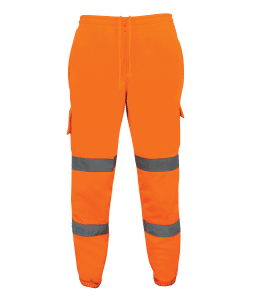
3. FR Hi-Vis Trousers
Trousers are typically paired with an FR polo shirt or sweatshirt to build a complete dual-certified outfit. Check for FR-rated zip pulls and fasteners, since standard metal hardware can retain heat. For roles involving bending, lifting, or kneeling, a bib and brace style trouser reduces the risk of gaps opening at the waist during movement.
4. FR Hi-Vis Bib & Brace
Bib and brace overalls work well for ballast loading, heavy lifting, and general track maintenance where full coveralls would be too restrictive. They offer better ventilation than a one-piece coverall while still protecting the torso. Look for 360-degree reflective leg tape and adjustable buckles that maintain a secure, gap-free fit throughout a shift.
5. FR Hi-Vis Bodywarmers
Bodywarmers are useful for transitional weather, but there’s a critical catch: the bodywarmer itself must carry FR certification. A non-FR bodywarmer worn over a certified FR shirt effectively voids the protection, because the outermost exposed layer is the one that determines compliance in a flash-fire scenario.
6. FR Hi-Vis Sweatshirts & Knitwear
For mild-temperature maintenance work, an FR hi-vis sweatshirt offers comfort without the bulk of a full jacket. Zip-neck styles are common for easy ventilation control. It’s worth confirming the fabric is inherently FR — typically a modacrylic blend — rather than chemically treated, since treated fabrics can lose flame resistance faster over repeated washes.
7. FR Hi-Vis Accessories & Base Layers
Neck gaiters, balaclavas, and FR hi-vis t-shirts round out a complete protective system, particularly for workers exposed to cold or sparks around the neck and head. One important warning: a standard non-FR hi-vis vest must never be worn as a top layer over FR clothing — it defeats the purpose of the entire system and is a surprisingly common error on site.
EN ISO 11612 vs EN ISO 14116 vs EN 61482: Which FR Standard Do You Need?
 Not all “flame retardant” labelling addresses the same hazard:
- EN ISO 11612 — full heat and flame protective clothing; the baseline standard for general trackside FR work.
- EN ISO 14116 — limited flame spread protection; lighter weight, suited to spark and ember exposure such as welding, but not full thermal protection.
- EN 61482 — arc flash protection, specifically required for work near live 25kV overhead line equipment.
Recommendation: EN ISO 11612 as the baseline for general trackside duties, upgrading to EN 61482-rated garments for any role involving live electrical infrastructure.
How to Care for FR Hi-Vis Clothing (So It Stays Certified)
FR and hi-vis certification isn’t permanent — it can be degraded through everyday use and incorrect laundering:
- Never use fabric softener. It coats FR fibres and can significantly reduce flame resistance.
- Inspect regularly for UV fading of the orange dye and for reflective tape lifting or cracking.
- Retire garments immediately if tape peels, seams fail, or fabric tears — the classification becomes void the moment the garment no longer matches its tested condition.
UK vs US vs EU Rail FR Compliance: A Quick Global Comparison
For multinational rail contractors, standards vary by region:
- UK: Driven by RIS-3279-TOM, with mandatory orange hi-vis trackside.
- EU: PPE Regulation 2016/425 governs CE marking, with EN ISO standards (20471, 11612) applied across member states.
- US: OSHA and FRA rules focus on thermal hazard rather than colour, referencing NFPA 2112 for flash fire and ASTM F1506 for arc flash protection.
Conclusion & FAQ: Rail Hi-Vis + FR Clothing
Trackside safety demands more than bright colours — it demands clothing engineered for both visibility and thermal risk. Choosing dual-certified garments, matching the correct FR standard to the task, and maintaining certification through proper care are all essential parts of a compliant rail PPE strategy.
Can I get hi-vis and FR protection in one garment? Yes — look for dual CE pictograms on the label confirming both EN ISO 20471 and EN ISO 11612 (or the relevant FR standard) compliance.
Is orange or yellow required for UK trackside work? Orange is mandatory under RIS-3279-TOM for trackside roles.
Before ordering, review your team’s specific hazard exposure and layering needs, and seek guidance on building a compliant dual-certified rail workwear system rather than assembling separate hi-vis and FR pieces that may not meet requirements together.